UK Self Assessment calculators for 2025/26 and 2026/27
Estimate Income Tax and Class 4 National Insurance, plan payments on account, check late-filing penalties, decode a tax code and sketch a student loan repayment. Figures come from official GOV.UK rates pages re-fetched for this edition. AssessTally is independent and is not affiliated with HMRC. Estimates only — not tax advice. You can file online for free on GOV.UK.
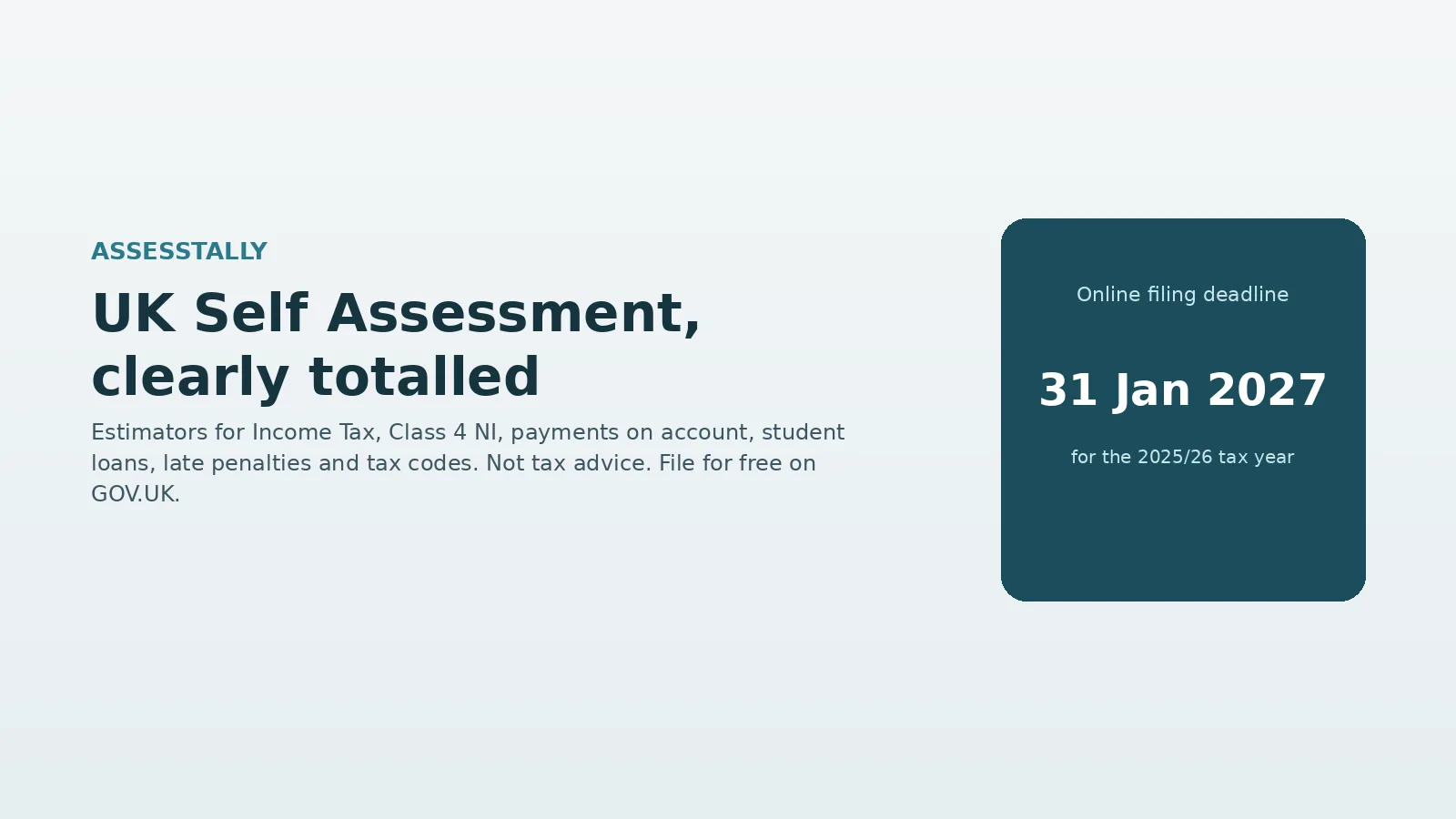
Self Assessment tax calculator File online for free on GOV.UK
Calculators
Self Assessment tax calculator
Estimate UK Income Tax and Class 4 National Insurance for 2025/26 or 2026/27, for England, Northern Ireland, Wales or Scotland. Optional savings, dividends and student loan. Not tax advice.
Payments on account calculator
Work out whether Self Assessment payments on account are due, each half-year instalment, and a typical 31 January balancing payment plus first instalment. Official £1,000 and 80% tests.
Student loan repayment calculator
Estimate UK student loan repayments for 2025/26 or 2026/27 on Plan 1, 2, 4 or 5 and the Postgraduate Loan, using official annual thresholds. Not a loan balance.
Late filing and payment penalty calculator
Estimate official UK Self Assessment late-filing and late-payment penalties from how many days late you are and the tax due. Interest in pounds is not invented.
UK tax code decoder
Decode common UK tax codes including 1257L, emergency 1257L W1/M1/X, BR, D0, D1, NT, 0T, K codes, and S or C prefixes. Not confirmation that the code is correct for you.
Popular guides
Self Assessment deadlines for 2026 and 2027
Official HMRC deadlines for the 2025/26 Self Assessment tax year: paper (already passed), pay through a tax code by 30 December 2026, and file and pay online by 31 January 2027.
What are payments on account?
A plain-English guide to Self Assessment payments on account: when they are due, the official £1,000 and 80% tests, balancing payments, and how to ask HMRC for a reduction.
Self Assessment late filing and late payment penalties
How HMRC’s official late-filing and late-payment penalties work, including the £100 charge, £10 daily penalties, the 5% or £300 steps, interest, and failure to notify.
UK Income Tax rates for 2025/26 and 2026/27
Official UK Income Tax bands and dividend rates for 2025/26 and 2026/27, including the Scottish starter-band change and the rise in ordinary and upper dividend rates.
Who needs to file a Self Assessment return?
Who must send a UK Self Assessment return, official reasons including self-employment over £1,000, partners, Capital Gains Tax and the High Income Child Benefit Charge, and how to check.
How to file a Self Assessment return online for free
How to register for Self Assessment and file a UK tax return online for free with HMRC, what you need, who cannot use the free service, and where paid software fits in.
How we work
AssessTally is an independent publisher, not a government website and not a firm of tax advisers. We turn official rates, deadlines and penalty schedules into browser tools, cite every source, and keep your inputs on your device. If a GOV.UK page and this site ever disagree, the official page wins.
Frequently asked questions
When is the Self Assessment deadline for 2025/26?
The tax year being filed now ran from 6 April 2025 to 5 April 2026. HMRC must receive your online return and any tax you owe by 23:59 on 31 January 2027. To pay through your tax code, you must submit the online return by 23:59 on 30 December 2026. The paper-return deadline of 23:59 on 31 October 2026 has already passed.
Is AssessTally official HMRC software?
No. AssessTally is an independent publisher and is not affiliated with HMRC or GOV.UK. The calculators are estimates only and are not tax advice. You can file your return online for free on GOV.UK.
What do the calculators include?
The main estimator covers Income Tax (England, Northern Ireland and Wales, or Scotland) and Class 4 National Insurance on self-employment profits, with optional savings, dividends and a student-loan estimate. Separate tools cover payments on account, late-filing and late-payment penalties, student loan repayments and tax-code letters.